Tuesday, February 1, 2011

Roasted Beef Bone Marrow

P1150040

I’ve been wanting to try beef marrow, especially since I read about them in this cookbook - .  As I was shopping in Whole Foods a couple of weeks ago, these frozen marrow bones literally jumped into my consciousness from my peripheral vision.

P1150015

One is supposed to soak the bones in changes of salted water for 12-24 hours to leach out the blood. I thought they looked good at 12 hours and was anxious to try them; but, as you can see, there was still a bit of blood in them. At least it flaked off easily before we ate them on crostini.


P1150041

Having no marrow spoons, we used the handle of some narrow spoons to spread the marrow on the crostini. We served them with a nice red wine and some pesto (for a “green vegetable” angle to the meal). It was like eating beef butter on toast – very unctuous; rich, fatty, and delicious.

Sunday, January 2, 2011

Sous Vide Supreme

Technorati Tags: ,,,
PC230049

I convinced my husband that if I got a Sous Vide Supreme for Christmas, it would be a great excuse to use our blowtorch more often.


PC230053

First, I made creamy scrambled eggs with thyme cooked at 158 F for 1 hour. Served with my bacon.


PC260056

Then, beef short ribs at 135 F for 48 hours.


My husband torching the short ribs.


OLYMPUS DIGITAL CAMERA

Served with cauliflower pureed with horseradish and cheddar cheese. As I’ve learned from further reading, large bits of fat might not render out at this low temperature. The ribs were fork tender, but a bit “blubbery”.  I’ll try a higher temperature next time.


PC280067

Next up, chicken breasts with herb sachets: sage, thyme, and oregano.  Cooked at 140 F for 3 hours.


PC280062

In   it is recommended to wrap herbs in plastic wrap to make sachets so the herbs don’t come in direct contact with the food and create sites of overpowering flavor. The juices from the meat seep in the cut ends of the plastic wrap and steep the herbs to extract the flavor.


PC280071

I quick-chilled 4 of them to freeze for later.


PC280073

Rather than sear the two chicken breasts with oregano that I was serving for dinner, I made a sauce with sundried tomatoes, goat cheese, lemon juice, garlic and basil.


PC280077

Very tender, juicy, and tasty (except for too much lemon juice in the sauce).  I wish I had thought to take a photo of a cut surface of the chicken breast.


PC290080

Prime rib eye steaks.


PC290089

After cooking 4 hours at 135 F.  I had planned to take them out after 2 hours but my husband had to work late unexpectedly – not a problem with Sous Vide.


PC290091

Seared in an enameled cast-iron skillet.


PC290093

I think we might have seared them a touch too long.  Almost have a grey ring at the very edge, but not too bad.  Certainly not a regular bull's-eye you’d get from grilling. Nearly perfect medium-rare throughout.

Sunday, November 21, 2010

Osmanthus (Sweet Olive) Sweet Water Ice & Hudson Valley Duck Confit

Osmanthus Ice & Duck Confit20101120_08

I recently found some lovely floral extracts from Silver Cloud Estates. Osmanthus, Jasmine, Rose, Pimento (Allspice)… I bet their vanilla is very good too. I lurve sweet olive and have enjoyed many iterations of Harold McGee’s various Ice recipes from The Curious Cook: More Kitchen Science and Lore (Fig, Mango, Strawberry). This is from his Sweet Water Ice chart for “Water” infusions.

I dissolved 2 1/2 C. sugar in 4 C. water and added 2 Tb. Lemon juice, 4 Tbs. Osmanthus extract and then added about 1/2 C. water to bring the total to just under 6 C. of liquid which will fit in my KitchenAid Ice Cream maker attachment. I had added the extract and lemon juice teaspoon by teaspoon to try to get the correct flavor (cold foods usually need to be stronger than those at room temperature to get the same effect).  It seems to taste stronger than what I thought it would, so I may cut back on the extract next time for guests (though I like it over-the-top for myself).  By luck, my Sweet Olive trees were in bloom to provide a fresh flower garnish.

At the opposite extreme of cooking from scratch, my local grocery store – Calandro’s – has recently started stocking Confit de Canard from Hudson Valley Foie Gras.

So our decadent, almost fast-food meal consisted of steamed broccoli with Plugra butter, sea salt, and fresh-ground black pepper;  skillet heated duck confit with crostini from Whole Foods French baguettes. Almost an unventing of the universe.

Osmanthus Ice & Duck Confit20101120_01

Osmanthus Ice & Duck Confit20101120_04

Osmanthus Ice & Duck Confit20101120_07

Steamed broccoli with Plugra, pan-seared duck confit, baguette crostini, and Pinot Noir from Saxon-Brown Winery.

I had to sneak out in the middle of the night and have “just-one-more” bite of the Osmanthus Sweet Ice before I went to bed.

Osmanthus Ice & Duck Confit20101120_09

Thursday, September 9, 2010

McDonald’s type French Fries and Fresh Ground Beef Burgers

OLYMPUS DIGITAL CAMERA

I’ve been looking forward to trying this method for making McDonald’s type French Fries at home ever since I read this post, How to Make Perfect Thin and Crisp French Fries, by J. Kenji Lopez-Alt. My husband just completed 3 months of exercise and dieting, and wanted to have an over-the-top nasty (in a good way) dinner to celebrate. I decided I wanted to try frying the potatoes in beef fat for old-style McDonald’s fries.


OLYMPUS DIGITAL CAMERA

My husband persuaded a local butcher to save us some beef fat to render for frying. This is 12 lbs. trimmed beef fat ready to go in a slow oven to render over several hours.


McD's Fries and Fresh Burger20100906_09

After straining and cooling overnight; I got lovely, creamy-white beef tallow.


McD's Fries and Fresh Burger20100906_07

The fries must be exactly 1/4 inch for the process to work. My Oxo mandoline worked very well with the French Fry insert.


McD's Fries and Fresh Burger20100906_11

The cut potatoes must be parboiled in acidulated, salted water until tender. Unfortunately, I made a slightly larger batch than called for in the recipe and since the water took longer to come to a boil, the potatoes were overdone. It finally occurred to me to check them before the time specified, but I was a bit too late. They didn’t crumble into mashed potatoes, but most of the long ones broke in half when I drained them. I’ll start checking them much earlier next time.

After drying on a paper towel-lined baking sheet, I fried the potatoes in the beef fat for 50 seconds, then spread them on another paper towel-lined sheet and froze them for several hours. They are supposed to be even closer to McD’s fries if frozen overnight, but I didn’t have the time.


McD's Fries and Fresh Burger20100906_14

I wanted a great burger to serve with the fries, so I adapted another of Kenji’s recipes:  The World's Best Burger for a Single Man (or Woman). I ground a well-marbled chuck roast and some boneless beef short ribs with my KitchenAid meat grinder attachment.


McD's Fries and Fresh Burger20100906_15

Very minimal handling is key to preserve the ground beef “noodles” for a greater surface area for crisping and catching melted cheese, and to prevent a dense interior. I ground the meat directly onto the lined sheet pan and gently coaxed the burgers into shape.


P9060018

A close-up of the desired loose structure of the patty.
 

McD's Fries and Fresh Burger20100906_19

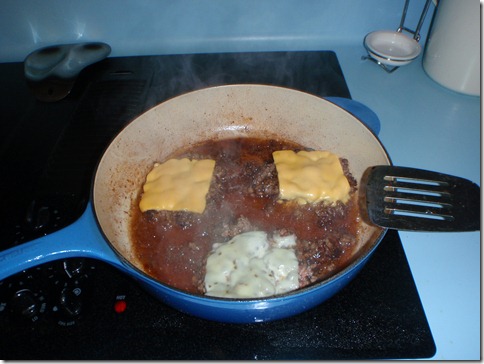
The burger recipe called for frying one burger at a time (hence the “Single” modifier) in a small skillet so the fat from the burgers would get about 1/8” deep to get the edges as crispy as the bottom. To get all the burgers to finish as the fries were getting their final 3.5 minute fry (by my husband outside on the grill side-burner), I just added a bit of the beef tallow I had made to reproduce the effect.
 

McD's Fries and Fresh Burger20100906_23

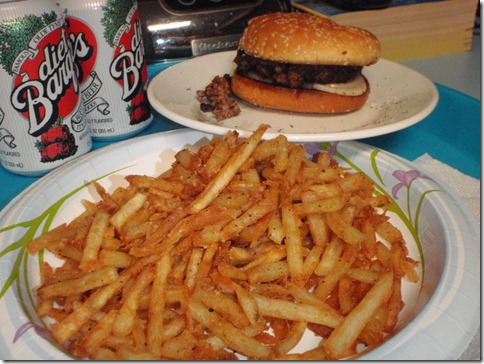
My goodness! Everything came out so delicious. The burgers were crispy outside – tender and juicy inside with lots of crags for the cheese to melt into. The fries (though shorter than they could have been) were light-golden bits of heaven. They were fluffy inside, not greasy (really), and stayed crispy to the last fry. I hope to get the gumption to make some batches up to the freezing stage (they are supposed to keep frozen for 2 months). How nice to be able to serve fresh fries like this in just a few minutes. But, I’ll think I’ll just buy the tallow next time…


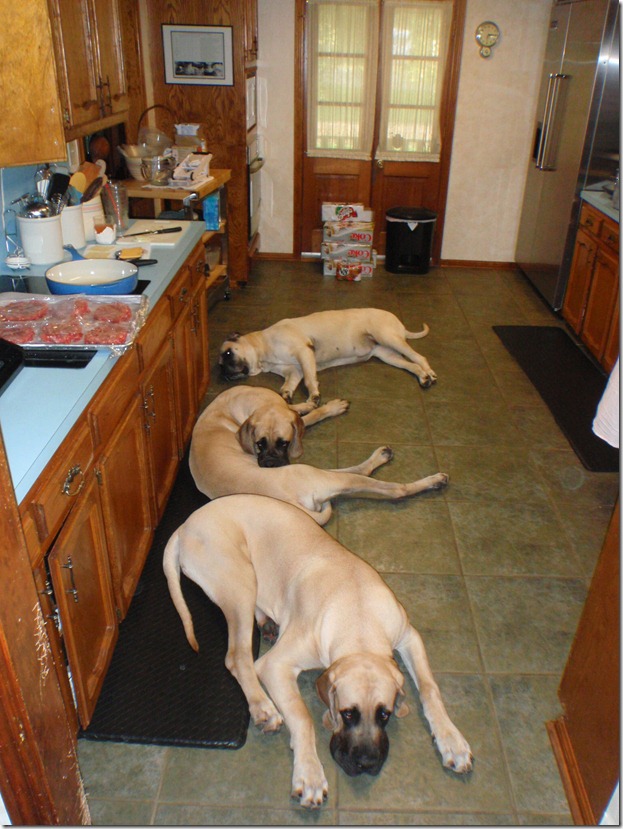
Can I get a little extra credit for difficulty - cooking in the American Mastiff Obstacle Course?
OLYMPUS DIGITAL CAMERA

Wednesday, August 18, 2010

Ice Chest Sous Vide

Cooler Sous Vide Steak08152010_11

Ah, near perfect medium-rare steak from edge to edge with no large, grey ring of overdone meat around the sides. (I’m sorry the plate is so messy; I’m always rushing to eat when the food is done and forget proper plating.)

I’ve been interested in trying sous-vide for a couple of years but didn’t want to try to build a homemade system and certainly couldn’t afford a commercial setup. With the SousVide Supreme now available for home use, the technique is approaching the realm of the possible; but I wanted to give it a trial run before thinking of plunking down around $500 (though it’s not that much more than a nice KitchenAid mixer). Thanks to J. Kenji Lopez-Alt at Serious Eats, a limited version (not hot enough for vegetables, thickness of meat and cooking time limits) of sous-vide is possible for just about anyone. In the comments section of the article Cook Your Meat in a Beer Cooler: The World's Best (and Cheapest) Sous-Vide Hack, I found a wonderful calculator Sous-Vide in a Cooler - water temperature calculator that will tell you what temperature of water is needed based on the dimensions of your cooler; type and starting and ending temperature of the meat, etc. Check out Kenji’s Sous-Vide 101: Prime Steak Primer for a detailed explanation of the process.


Cooler Sous Vide Steak08152010_04

Start with a couple of rib-eyes.


Cooler Sous Vide Steak08152010_06

Season with fresh-ground black pepper and Kosher salt and enclose in plastic. You can use Ziploc bags with the immersion method to remove as much air as possible, but it’s nice to vacuum seal the bags if you have one.


Cooler Sous Vide Steak08152010_07

The steaks relaxing in their (should have been) 139.6 degree bath. (I swear I scrubbed out the cooler – those are stains – not dirt. And the steaks are vacuum sealed anyway.) I was pretty lucky for a first try. My hot tap water is 130 degrees. I filled the cooler to 8” deep with the hot tap water then added 1” of simmering water from a large pot on the stove. It looked like about a gallon of simmering water (and that’s what the Sous-Vide in a Cooler - water temperature calculator shows). I had figured on a final water depth of 9” and the temp. was 139.9 degrees at this point. I probably should have added some ice to get the temp. to 139.6, but I was afraid to mess with it too much. That may be why the steaks weren’t quite perfectly medium-rare; or, perhaps the final sear on the charcoal grill lasted a tiny bit too long. I’m sold on the technique, however. The steaks were tender, juicy and delicious. There’s no need to rush with sous-vide steaks. Suddenly decided you want to oven-bake rather than microwave your potatoes, forgot to decant the wine, or expecting chronically-late dinner guests? The steaks will stay at your chosen doneness for another hour or two, no worries.

Monday, August 16, 2010

Goat Cheese Stuffed Peppadew Peppers

Goat Cheese Peppadews08112010_02

I only recently heard about Peppadew peppers (though they’ve been around for several years), so when I saw them at Martin’s Wine Cellar, I had to give them a try. I thought they would be good stuffed with goat cheese. I’ve made a goat cheese spread before with a bit of butter blended in to make it spreadable, but decided to try a bit of Colatura (a wonderful essence of anchovies I also only recently heard about).


Goat Cheese Peppadews08112010_04

I drained the peppadews in a sieve, blended about a tablespoon of the colatura into the softened goat cheese, and stuffed the peppers.


Goat Cheese Peppadews08112010_07

I placed them under the broiler until the cheese was warm and bubbly, and the peppers charred just a bit. Wow, it was hard to share half of them with my husband. They are addictive – sweet peppers with just a bit of heat – tangy goat cheese with that extra bit of umami from the colatura. I ordered a case of the peppadew peppers so we can have them often. I may even be able to part with some for guests.

Saturday, June 26, 2010

Mai Tai

OLYMPUS DIGITAL CAMERA
My first job in high school was at a Tiki restaurant in Key Largo with the Polynesian fire dancers, Pu-Pu platters, and tropical drinks…
I recently found Beachbum Berry’s Sippin’ Safari, “America’s leading authority on tropical drinks and Polynesian pop-culture” on Amazon and have started to collect the myriad ingredients necessary to recreate these tropical libations.

Rums for tropical drinks
I found most of the rums at Martin’s Wine Cellar, though I still need a good Demerara 151 for Zombies.

Mai Tai20100626_03
Mise for the Mai Tai: Aged Martinique and aged Jamaican Rum, lime juice, simple syrup (in the Grolsch bottle), Orgeat syrup, and Cointreau [A fine, colorless, orange-flavored liqueur made from the dried skins of Curaçao oranges grown on the island of the same name in the Dutch West Indies. The Generic term is Curaçao, and if redistilled clear is called triple sec. "...before Prohibition the Cointreau bottle still read Cointreau Triple Sec. The liqueur was not only the first triple sec, it's how the term was coined. After imitators reproduced the signature square bottle and imprinted the words "Triple Sec" in the Cointreau typeface, Cointreau dropped the words from their bottle. The premium liquor has long since transcended the category, but that's how it started out...the first and best triple sec. ... Use generic triple sec only if you are short on cash."].